
3D/4D Ultrasound: Best Time, Safety, and What You'll Actually See

3D4D Ultrasound Best Time, Safety, and What You'll Actually See

What This Article Covers

In this article, we will discuss how 3D and 4D scans are different and help you understand the best time for a 3D/4D ultrasound, what you may see, how safe it is, and how it differs from routine pregnancy scans.

A Little Closer to Meeting Your Baby 

For expecting parents, it’s natural to be excited and curious about their baby. You’ve probably spent a lot of time already imagining the little person you’re about to meet. You might wonder whether they’ll have your eyes, your partner’s smile, or a completely unexpected combination of features. Routine pregnancy ultrasounds help assess your baby’s development and other aspects of your pregnancy. A 3D/4D ultrasound can offer a more realistic view of your baby’s growth and movements. It allows you to see more lifelike images of your baby’s features and, with 4D imaging, their movements. Simply put, it can give you a closer look at your baby’s face. If you’re considering one, it’s worth knowing when to book, what the scan can show, and how it fits alongside your routine pregnancy ultrasounds.

The Difference Between 3D and 4D Ultrasound

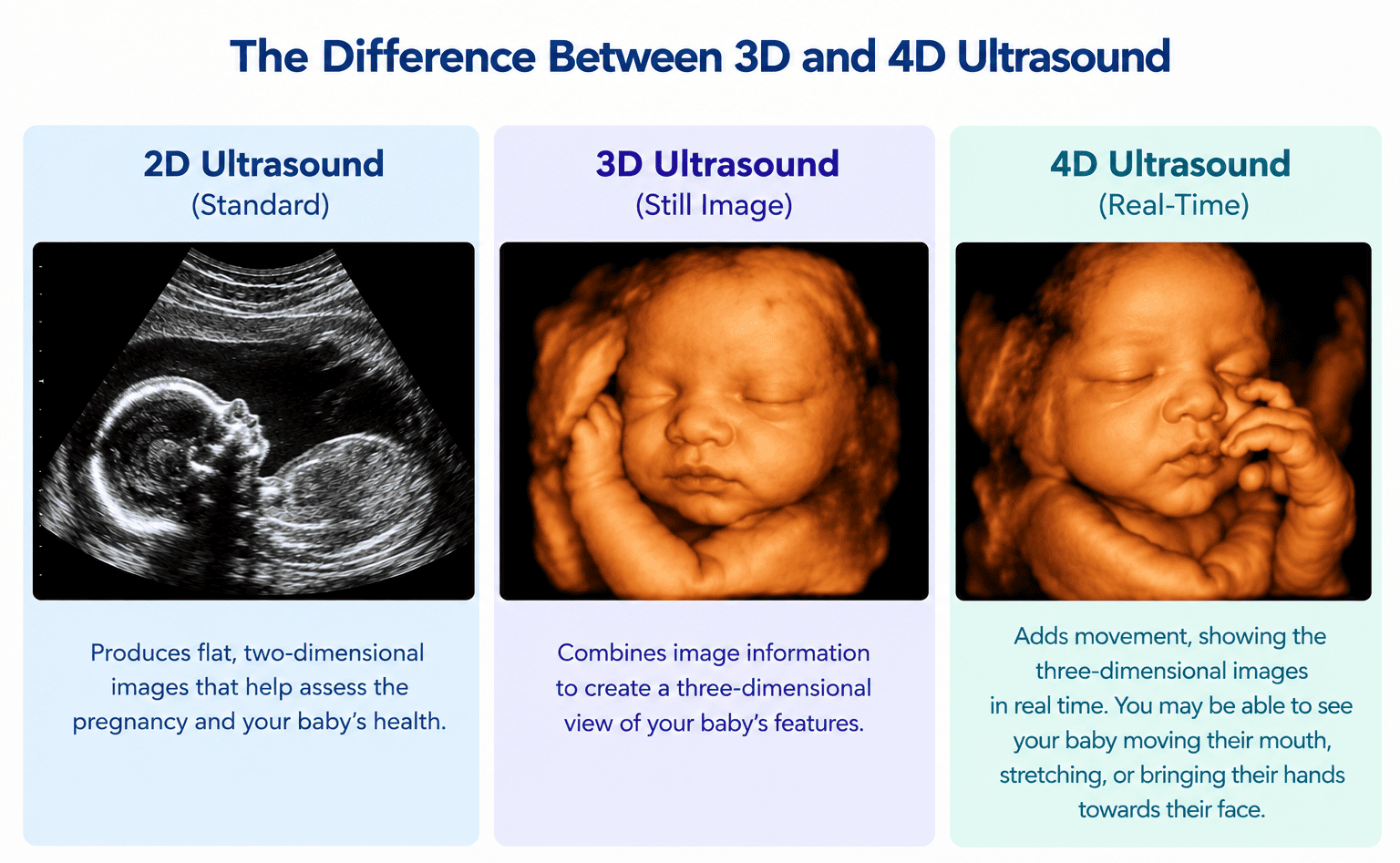
If you’re pregnant, you’ll often hear about the process, purpose, timing, safety, and what to expect from routine pregnancy ultrasounds. So, it’s normal to wonder the same for 3D/4D scans too. In 3D and 4D scans, the main difference comes down to how the images are displayed. A standard 2D ultrasound produces flat images that help assess the pregnancy, while a 3D ultrasound combines image information to create a three-dimensional view of your baby’s features. A 4D ultrasound adds movement, showing these three-dimensional images in real time. You may be able to see your baby moving their mouth, stretching, or bringing their hands towards their face. If you’re an expecting parent curious to see your baby more clearly, a 3D scan pregnancy experience can offer a different way to see your baby’s developing features.

The Difference Between 3D and 4D Ultrasound

When Is the Best Time to Book a 3D/4D Ultrasound Scan?

Timing can make a difference to what you see. Elective 3D/4D ultrasound scans are often booked around 22 to 28 weeks of pregnancy, although the preferred timing can vary between providers and pregnancies. At this stage, your baby’s facial features may be more developed, but a clear image is not guaranteed. The quality of the images and what’s visible depends on several factors, including your baby’s position, whether their face is turned towards the probe, and whether their hands or the umbilical cord are in the way. Sometimes, your baby simply isn’t in the right position for a clear view, even when the timing seems ideal.

Is a 3D/4D Ultrasound Safe for Your Baby?

As parents, it’s natural to wonder whether an additional scan is appropriate for your baby, particularly when you’re already attending routine antenatal appointments. Ultrasound uses sound waves rather than ionising radiation and has an established role in pregnancy care when performed appropriately. However, an elective scan for images of your baby’s face is different from an ultrasound recommended to assess your pregnancy.

Any ultrasound should be performed by a suitably qualified professional using appropriate equipment and following relevant safety guidance. A 3D/4D scan intended to show your baby’s features does not replace a dating scan, morphology scan, or any other imaging recommended by your healthcare professional. If you’re considering an elective scan, discuss whether it’s appropriate for you with your GP, midwife, or obstetrician.

What Does a 3D/4D Ultrasound Show?

Depending on your baby’s position and the quality of the images, you may be able to see their nose, lips, cheeks, and other facial features. With 4D imaging, you might also catch a glimpse of your baby opening their mouth, moving their arms, or stretching during the scan. It’s worth keeping your expectations realistic, though. Your baby might have their face turned away, keep a hand over their face, or move just as the image is being captured. The amount of fluid around the face and other factors can also affect image quality. A scan may provide lovely images, but a clear picture of your baby’s face cannot be guaranteed.

3D/4D Scan vs Dating Scan: What’s the Difference?

No. An ultrasound dating scan helps estimate how far along you are in your pregnancy and establish an estimated due date. Other routine pregnancy ultrasounds may assess your baby’s anatomy, growth, or other aspects of the pregnancy, depending on the purpose and timing of the examination. Understanding when different pregnancy ultrasound scans are performed can help you know what to expect at each stage of your pregnancy.

A 3D/4D scan, on the other hand, is primarily associated with viewing your baby’s features and movements. It should not replace a dating scan, morphology scan, or any other ultrasound recommended by your healthcare professional. Keeping up with your routine antenatal care remains important, even if you’re planning an elective scan as well.

Planning Your Pregnancy Scan 

Seeing your baby’s features or movements can be a special experience, but a 3D/4D ultrasound scan is optional and does not replace routine antenatal care. If you’re considering one, speak with your GP, midwife, or obstetrician about whether it’s appropriate for you.

Contact Insight Diagnostic Imaging today to discuss your pregnancy ultrasound options and arrange an appointment. Our team can help you understand the available services and what to know before booking.

Frequently Asked Questions 

1. When is the best time to have a 3D/4D ultrasound?

Many elective 3D/4D ultrasound scans are often booked around 22 to 28 weeks of pregnancy, although timing can vary. Your baby’s position and other factors affect image quality, so a clear view cannot be guaranteed.

Ultrasound uses sound waves rather than ionising radiation and is widely used in pregnancy care when performed appropriately. Elective scans should follow relevant safety guidance and should not replace medically recommended pregnancy ultrasounds.

It may show features such as your baby’s nose, lips, and cheeks, but clear images are not guaranteed. Your baby’s position, movements, and whether their face is partly covered can affect what is visible.

A 3D scan creates a three-dimensional image of your baby’s features, while a 4D scan shows these images in real time, allowing you to see movements such as opening the mouth or moving the hands.

No. A dating scan helps estimate gestational age and your due date. A 3D/4D scan is primarily used to view your baby’s features and movements, so it does not replace a dating scan or other recommended antenatal imaging.

Your baby’s position can affect the images, particularly if their face is turned away or covered by their hands. The sonographer may allow time for your baby to move, but a clear facial image cannot always be obtained.

Related Posts