If you have any questions about what you need to do to prepare for your ultrasound appointment, please contact us as early as possible.
You can MESSAGE us
Any time on our Contact page.
You can READ frequently
asked questions on our FAQ page.
Learn what FibroScan measures, why doctors recommend it for liver disease, how it helps assess fibrosis and fatty liver, and what to expect during the test.
Has your doctor referred you for a liver FibroScan, and you’re wondering why? You might feel completely fine on the outside while your liver undergoes significant changes without giving you a clear warning. Fat can build up, inflammation can occur, and scar tissue can develop while you continue with your normal routine. So if your doctor suspects something like this and wants a closer look at your liver health, they might suggest a FibroScan. A FibroScan gives doctors a non-invasive way to look for some of these changes. It can measure liver stiffness and fat without the use of needles, surgery, or radiation. But what exactly does a liver FibroScan measure, and why might your doctor suggest one? In this blog, we’ll explore the answers to these questions.
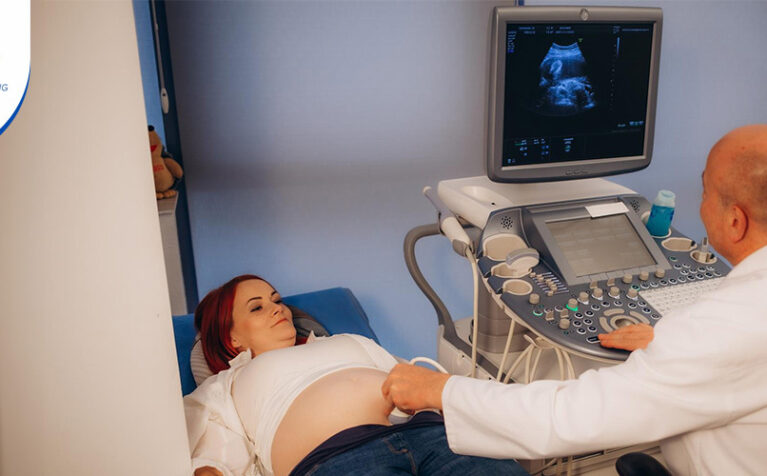
A FibroScan is a non-invasive test that uses transient elastography to measure your liver health. Just like ultrasound technology, a FibroScan also uses sound waves to determine the fat content and stiffness in the liver. It can also measure fat accumulation (steatosis) in the liver using a measurement called the Controlled Attenuation Parameter (CAP). It can be very helpful when investigating or monitoring fatty liver disease. While most people confuse it with ultrasound scans, it is technically different from a conventional ultrasound. A standard liver ultrasound is like a camera that creates images that doctors can use to examine the liver’s structure and surrounding organs. A FibroScan, on the other hand, is more like a measuring tool, helping doctors assess how stiff the liver is and also estimate fatty change.
The main purpose of a Liver Fibroscan test is to assess your liver for fibrosis and determine how significant it could be. When repeated injury or inflammation causes scar tissue to build up in the liver, it can cause fibrosis. If your fibrosis is mild, you may see few or no symptoms, but more advanced scarring can affect how your liver functions.
A FibroScan provides a measurement of stiffness that can help your doctor assess the likelihood and severity of fibrosis. However, it’s just one part of the picture, not a full diagnosis. Your doctor may also consider blood tests, medical history, symptoms, and other scans or tests along with this scan.
You may not even realise, and your liver might be struggling with issues internally. Also, sometimes it’s hard to determine the cause of a liver condition or symptom by looking at physical symptoms or blood tests alone. That’s where most doctors go for FibroScan to get an accurate idea of what’s happening inside your body. Sometimes, your doctors might also use FibroScan to understand whether liver scarring has progressed over time. Here are some reasons why your doctor may suggest a liver FibroScan:
Yes, a Fatty liver FibroScan can detect fatty liver disease by measuring the amount of fat accumulated in the liver. It uses a measurement called Controlled Attenuation Parameter (CAP) to evaluate hepatic steatosis (fat buildup in the liver). While fatty liver and liver fibrosis are different, sometimes fatty liver can progress to inflammation and lead to fibrosis. So, it can be better and more useful to assess both.
A FibroScan is usually quick and straightforward. When you walk into your appointment, the sonographer will ask you to lie on your back with your right arm raised while they place the probe against the skin over your liver. The probe sends gentle vibrations into the liver and measures how quickly they travel through the tissue. Your sonographer may take several readings to produce a reliable result. However, there are no needles or injections involved, and the test is generally painless. Also, there’s no special preparation needed for this scan, but you may be asked to fast before some examinations. Simply follow any instructions provided by your imaging provider for a comfortable experience.
No. Although both tests use ultrasound technology, they have different purposes. A FibroScan primarily measures liver stiffness and fat, while a standard liver ultrasound service creates images of the liver and surrounding structures.
| Liver Ultrasound | FibroScan |
|---|---|
| Creates images of the liver and surrounding organs | Measures liver stiffness and liver fat |
| Assesses the liver’s size, shape, and structure | Helps assess fibrosis (scarring) and steatosis (fatty change) |
| Can identify cysts, masses, or other structural abnormalities | Does not provide detailed images of the liver |
| May also assess blood flow when Doppler ultrasound is used | Uses specialised elastography technology |
| Useful for assessing the liver’s physical appearance | Useful for assessing liver stiffness and monitoring liver disease |
While basically different, these tests can provide complementary information. A liver ultrasound looks at the liver’s structure and appearance, while a FibroScan provides measurements that help assess stiffness and fatty change. Depending on your symptoms, medical history, and referral, your doctor may recommend one or both tests.
Liver disease can develop without obvious symptoms, so doing the right tests is important. A FibroScan offers a quick, non-invasive way to assess liver stiffness and fatty change, helping your doctor understand and monitor your liver health.
Have a referral for a Liver FibroScan test? Contact Insight Diagnostic Imaging to arrange your FibroScan ultrasound at a convenient location. We also offer bulk bill ultrasound services for patients with a valid referral and Medicare eligibility. Book your FibroScan today and take the next step towards understanding your liver health.
A FibroScan is a quick, non-invasive test that measures liver stiffness and can also assess fatty change in the liver.
No. A liver ultrasound creates images of the liver and surrounding structures, while a FibroScan measures liver stiffness and fatty change.
Your doctor may recommend a FibroScan to assess or monitor liver fibrosis, fatty liver disease, or other chronic liver conditions.
No. A FibroScan is non-invasive and does not involve needles or incisions. You may feel a light tapping sensation from the probe.
Bulk billing may be available for eligible patients, depending on the referral, Medicare eligibility, and applicable Medicare requirements.