
If you have any questions about what you need to do to prepare for your ultrasound appointment, please contact us as early as possible.
You can MESSAGE us
Any time on our Contact page.
You can READ frequently
asked questions on our FAQ page.
This article will talk about why your doctor might recommend an ultrasound for a lump in the neck or thyroid, and discuss what the scan can look at, how it’s carried out and what happens after.
Is the lump under your skin part of your thyroid or a swollen lymph node? It’s not always obvious by sight or by touch. The cause of a lump can vary and a simple physical examination may not be sufficient. Your GP may well recommend an ultrasound of a lump to investigate what it might be. This uses sound waves to produce an image of the tissue underneath the skin and will help establish whether it’s part of the thyroid gland, a lymph node or some other soft tissue. A lump ultrasound will allow the underlying tissue to be looked at in more detail and will help your doctor to determine whether further investigation is required. Finding a lump can be quite a worrying thing but there are a number of possible causes and many of them are not cancerous. Your GP will take your symptoms and your examination findings into account before deciding whether imaging is required.
A neck lump can develop for different reasons, depending on its location and the tissue involved. Common possibilities include:
A lump at the front of your lower neck may well be thyroid-related. A lump elsewhere may have a completely different aetiology. A clinical examination will help your GP to work out what needs to be investigated.
A lump ultrasound will allow the sonographer to look at the size, position, shape and internal appearance of the lump. For a neck or thyroid scan, this will usually involve the thyroid gland itself, the surrounding lymph nodes and the adjacent soft tissues. The images can be used to differentiate between a cyst and a solid lump, to identify any thyroid nodules and to look at features which may require further investigation.
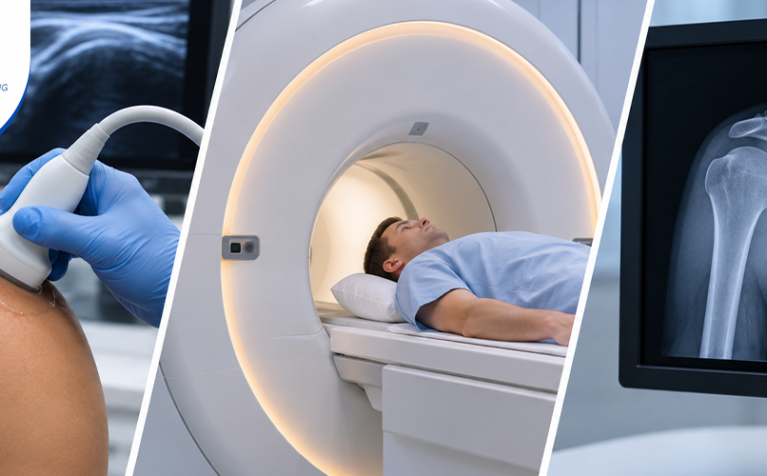
The same imaging modality can be used for a skin lump ultrasound or an ultrasound of a lump under the skin elsewhere in the body. The site being looked at and the type of scan will be determined by your symptoms and your GP’s referral. An ultrasound can be of great value, but it cannot always tell you what a lump is or indeed rule cancer in or out. Ultrasound is also commonly used to assess joints and tendons, for example a shoulder ultrasound for ongoing shoulder pain or a suspected rotator cuff problem.
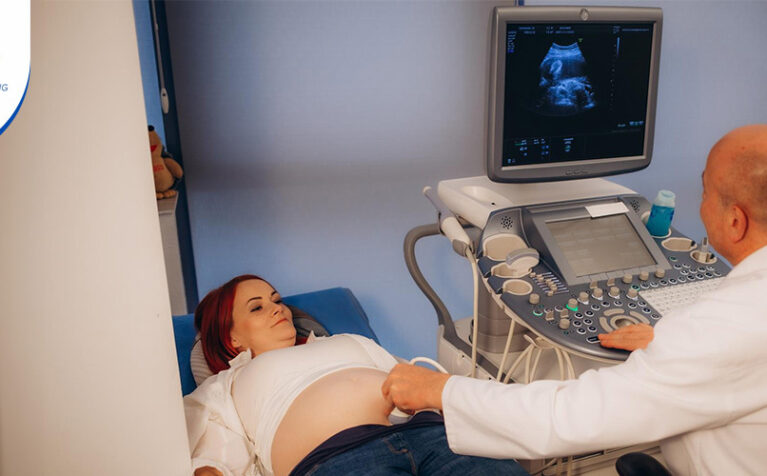
A neck ultrasound is pretty straightforward, really, and involves no needles or injections. You’ll normally be asked to lie on your back with your head slightly tilted back so that the front of your neck is as accessible as possible. The sonographer will apply a small amount of gel to your skin and then move the handheld probe around the area. You may feel a little pressure as the images are taken from various angles. They may well spend a bit of time looking at a particular area or checking out the lymph nodes in the region. Ultrasound uses sound waves rather than ionising radiation and is generally a painless procedure, although if the area does feel tender you can of course let the sonographer know.
Neck and thyroid ultrasounds don’t normally require you to fast. Just wear some comfortable clothes with an open or low neckline and take your necklaces off prior to the scan.
A radiologist will look at the ultrasound and produce a report for your referring doctor. Your GP will go over the report with you and will tell you whether any further action is required. The course of action will depend on the appearance of the lump, which may be as simple as monitoring it, blood tests, a specialist appointment or further investigation. In some cases, a fine needle aspiration may be recommended to take some of the cells from the lump for laboratory analysis. If your report does suggest further assessment is required, that does not necessarily mean the lump is malignant. Your doctor will make the final decision based on the report and your full clinical picture.
Medicare rebates and bulk billing are all dependent on the type of ultrasound, the clinical indication, the referral and the relevant Medicare requirements. A GP referral does not in itself mean that every ultrasound is eligible for a Medicare rebate. If you’re after a bulk billed ultrasound, then you need to check the billing arrangements prior to booking. You need to check whether the particular ultrasound you’re after is eligible and whether there will be any out of pocket costs.
If your GP has referred you in for an ultrasound to investigate a neck or thyroid lump, please contact Insight Diagnostic Imaging to book an appointment at either our Springvale or Dandenong clinic. We can assist with any queries you may have regarding appointments, referral requirements and billing. Call (03) 9522 9898 to discuss your ultrasound services and book your scan.
An ultrasound can pick up features which may be suspicious and thus assist in the decision as to whether further investigation is required. It cannot diagnose cancer by itself, and a biopsy or other tests may be indicated.
The vast majority of thyroid nodules are benign. Your doctor will likely do an ultrasound to assess the size and appearance of the nodule and will then decide whether you need to be followed up.
A neck ultrasound is generally painless. You may just feel a little pressure from the probe (particularly if the area is a bit tender).
Fasting is not usually required for a thyroid or neck ultrasound. Just follow any specific instructions given when you book.
The time taken for the examination will, of course, vary according to the area being looked at and whether further imaging is required. It’s worth asking the clinic when you book how long the appointment is likely to take.
A GP or specialist referral will go some way to identifying the area and the clinical issue that needs to be looked at. A valid referral is also important for checking Medicare eligibility.