
Shoulder Ultrasound vs CT scan vs MRI vs X-ray: Which One Do You Need First?

Shoulder ultrasound vs MRI vs X-ray_ which one do you need first_

What This Article Covers

In this article, we will talk about the differences between shoulder ultrasound, MRI, CT scan, and X-ray, discuss when each scan may be indicated and what to expect when you go in for your imaging.

Shoulder Pain? Which Scan Do You Need?

Shoulder pain can make the most mundane of activities quite difficult. Reaching into a cupboard, hanging the washing or just getting into a comfortable position in bed can all be quite painful if your shoulder isn’t moving properly. If your GP is recommending imaging, then you may be asking yourself whether you need an X-ray, CT scan, an MRI or a shoulder ultrasound. The different scans look at different things, so the right one for you will depend on your symptoms, the injury you are suspected of having and the clinical judgement of your doctor. There is no one scan that is appropriate for every shoulder problem.

What Is the Difference Between Shoulder Ultrasound, CT scan, MRI, and X-ray?

Although all three of the investigations are useful in the assessment of shoulder problems, they give you different information.

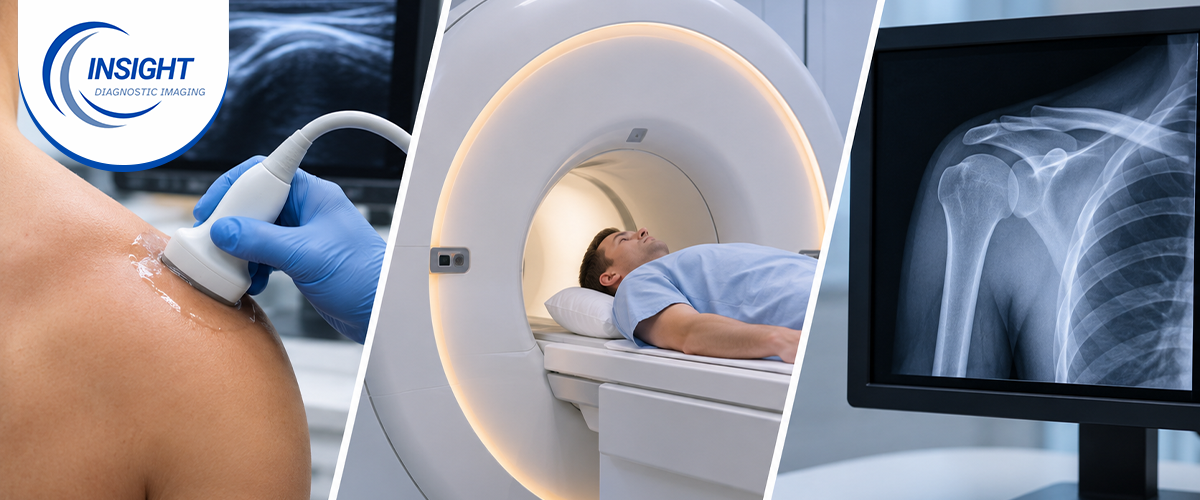
Scan What It Shows Common Uses
X-ray Bones and joints Fractures, dislocations, arthritis, and bone changes
Ultrasound Muscles, tendons, and other accessible soft tissues Rotator cuff injuries, bursitis, and tendon problems
CT Scan Detailed images of bones and complex anatomical structures. Particularly useful for assessing complex fractures, subtle bone injuries, and the extent of certain shoulder injuries.
MRI Detailed images of soft tissues, bones, cartilage, and joint structures Complex injuries and suspected damage inside the shoulder joint

Your doctor considers the suspected problem before recommending an examination. Sometimes, one scan provides enough information. In other cases, further imaging may be useful.

When Do You Need a Shoulder X-ray?

If you’ve got a recent shoulder injury, then an X-ray is likely to be the first imaging investigation that your doctor will suggest, especially if they’re concerned about a fracture or a dislocation. It can show you broken bones, changes in joint position, arthritis and certain calcium deposits around the shoulder. It won’t give you a detailed picture of the tendons and muscles, though. For acute shoulder pain in the Australian context, the diagnostic imaging guidelines generally recommend an X-ray as the first investigation where imaging is indicated.

When Is a Shoulder Ultrasound Recommended?

A shoulder ultrasound is one that’s commonly used when your doctor suspects some sort of soft tissue injury or pathology around the shoulder. It can be used to investigate:

  • Rotator cuff tears and tendonitis.
  • Bursitis (inflammation of the bursa, the fluid-filled sac that cushions the joint).
  • Biceps tendon problems.
  • Tendon calcification and various muscle injuries.

One benefit of an ultrasound of the shoulder is that the sonographer can assess certain tendons as you move your arm. That dynamic assessment can be very useful in terms of seeing how the structures are behaving. Ultrasound is, of course, a non-ionising form of imaging. It does have its limitations, though and is not capable of adequately assessing some of the deeper structures within the shoulder joint (for example, some labral injuries).

When Is a CT Scan Used for Shoulder Injuries?

A CT (computed tomography) scan uses X-rays taken from different angles to create detailed cross-sectional images of the shoulder. It’s especially useful when a doctor needs a closer look at the bones to assess a complex fracture, a subtle bone injury, or the damage caused by a shoulder dislocation. A CT scan may be recommended before an MRI when bone damage is the main concern. It may also be an option if an MRI isn’t suitable or can’t be performed. The two scans aren’t interchangeable: CT provides detailed images of bones, while MRI generally gives more information about many soft-tissue injuries. The right choice depends on what the doctor needs to investigate, not simply on which scan costs less.

When Might You Need a Shoulder MRI?

An MRI may be indicated if your doctor feels they need a bit more detail on the internal structures of the shoulder. This might be to look into a suspected labral tear, complex soft tissue injury or indeed to investigate something that’s still not quite clear following an initial examination or indeed following an X-ray or ultrasound. The MRI will use a strong magnetic field and radio waves to produce detailed images (no ionising radiation). It’s not something that will be done automatically following an X-ray or ultrasound. Your doctor will assess whether the extra information is likely to be of any benefit in terms of guiding your management.

Which Shoulder Scan Should You Have First?

There’s no single imaging pathway that works for every shoulder problem. Your GP or specialist will consider how the injury happened, your symptoms, and what they find during an examination before recommending a scan. If you’re getting a scan after an acute injury, an X-ray is often the first step to check for a fracture or dislocation. Further scans depend on what your doctor suspects. But for a suspected tendon or rotator cuff tear, Ultrasound or MRI may be used. CT can provide a closer look at a complex fracture or other bone injury. Your GP may also recommend an MRI when detailed images of the tendons, ligaments, cartilage, or other structures inside the joint are needed. However, you may not need all four types of scans. Each has a different role, and your doctor will recommend the one best suited to answer the clinical question.

What happens during a shoulder ultrasound?

A shoulder ultrasound is simple and non-invasive. You’ll either sit or stand, and the sonographer will apply gel to your shoulder and then move the probe around. You may be asked to move your arm into various positions so that the sonographer can look at the tendons as you do so. If your shoulder is already painful, then some of the pressure and positioning may be uncomfortable. There is no use of ionising radiation. Once the images have been looked at, a report is sent to your referring doctor.

Can you get a bulk billed shoulder ultrasound?

Insight Diagnostic Imaging provides bulk-billed shoulder ultrasound appointments for eligible patients with a valid Medicare referral. Medicare benefits for shoulder ultrasound are, however, subject to specific clinical indications and referral requirements. A referral for non-specific shoulder pain in itself will not entitle the patient to a Medicare rebate. If your GP or specialist has referred you for a shoulder ultrasound, get in touch with us to find out whether your ultrasound is eligible for bulk billing and whether you’ll be required to pay anything out of pocket.

Book a Shoulder Ultrasound at Insight Diagnostic Imaging

If your doctor has referred you for a shoulder ultrasound, Insight Diagnostic Imaging can help you arrange an appointment at either our Springvale or Dandenong clinic. We offer shoulder ultrasound with bulk billing available for eligible patients. Call us at (03) 9522 9898 to confirm your referral requirements, appointment availability and billing options. Get in touch with us today to arrange your shoulder ultrasound and take the next step in the investigation of your shoulder.

Frequently Asked Questions 

1. Is an ultrasound or an MRI better for a rotator cuff tear?

Both can assess rotator cuff tears. Ultrasound is useful for looking at the tendons that are accessible and their movement. MRI is better at looking at the deeper structures. Your doctor will decide which is the right one for you.

A written request from a doctor or other eligible health professional is generally required. Contact Insight Diagnostic Imaging to confirm the requirements for your scan.

The duration depends on the area examined and the scan protocol. Contact the clinic when booking to ask about the expected appointment time.

It depends on the type of ultrasound and your clinical circumstances. Your doctor may recommend further assessment or a repeat scan if DVT cannot be confidently excluded.

Insight Diagnostic Imaging bulk bills most ultrasound examinations for eligible patients with a valid referral and Medicare card. Contact the clinic to confirm whether this applies to your DVT scan.

Eligible patients may receive a bulk-billed shoulder ultrasound with a valid Medicare referral. Eligibility depends on the clinical indication and Medicare requirements. Contact the clinic to confirm.

Related Posts